 Skip to content

Participating in sports is an excellent way to maintain physical fitness and mental well-being. However, the high-velocity movements, sudden changes of direction, and repetitive loads of athletic training carry an inherent risk of injury. Whether you are a professional athlete or a recreational runner, acute or chronic pain can severely disrupt your routine. If you are an athlete dealing with physical pain, securing professional Sports Injury Treatment in Varanasi is vital for your long-term recovery.
At Ayaansh Ortho Center, our sports medicine team specializes in advanced, evidence-based treatments for athletic conditions. We focus on non-surgical and minimally invasive therapies to help you return to your sport safely. In this comprehensive guide, we will analyze four highly common athletic conditions: muscle strains, ligament sprains, hamstring injuries, and shin splints.

Choosing Specialized Sports Injury Treatment in Varanasi
Every athlete requires a customized recovery plan that addresses their specific sports biomechanics. Therefore, selecting professional Sports Injury Treatment in Varanasi is essential to ensure a complete, criteria-based recovery. An experienced sports medicine doctor will analyze your injury, physical demands, and gait mechanics before designing a treatment protocol.
Furthermore, ignoring early athletic pain can lead to chronic tissue degeneration. For instance, continuing to run on a partially torn hamstring can cause a complete tendon avulsion. At Ayaansh Ortho Center, we utilize advanced diagnostic imaging and progressive physical therapy to treat injuries at their source. This precise approach minimizes your downtime and prevents recurrent injuries.
1. Muscle Strain: Causes, Grades & Symptoms
First, we must examine muscle strains, which are often referred to as a “pulled muscle.” Specifically, a muscle strain occurs when muscle fibers or their connecting tendons stretch excessively or tear. This injury typically happens during explosive movements, such as sprinting, jumping, or heavy lifting.
The Grades of Muscle Strain:
- Grade I (Mild): A few muscle fibers are stretched or micro-torn. Consequently, the athlete feels mild pain and localized tightness. However, muscle strength remains completely intact.
- Grade II (Moderate): A significant number of muscle fibers are torn. As a result, the athlete experiences moderate pain, swelling, and visible bruising. Muscle strength is notably reduced, and movement is painful.
- Grade III (Severe): The muscle or tendon is completely ruptured. Typically, this injury causes a sharp, tearing sensation, severe swelling, and extensive bruising. Consequently, the athlete loses all muscle function. Occasionally, a visible dent or bulge appears under the skin.
Generally, strains most commonly affect the hamstrings, quadriceps, and gastrocnemius (calf) muscles. Consequently, seeking timely Sports Injury Treatment in Varanasi helps prevent minor muscle micro-tears from becoming chronic, scarred tissue.
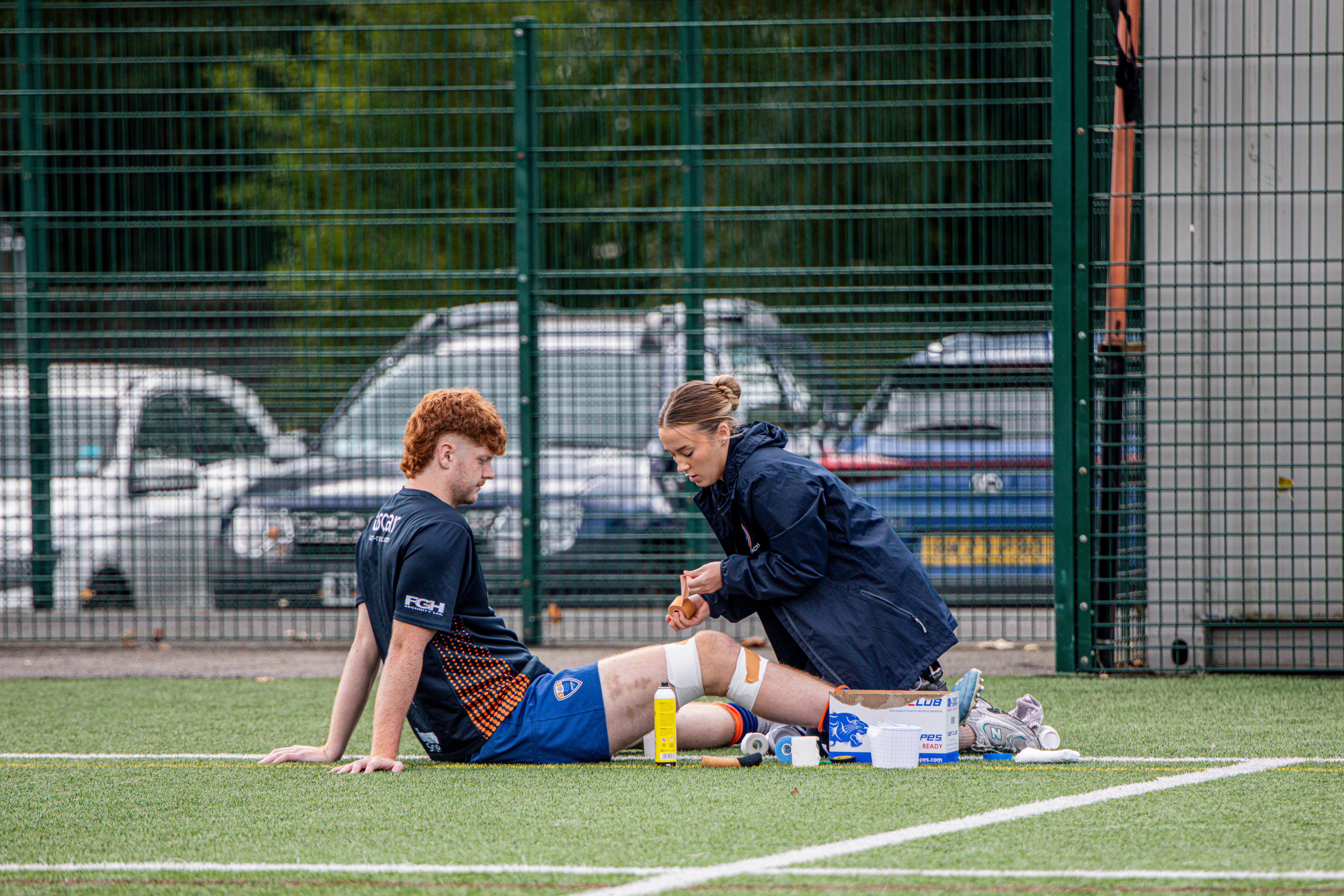
2. Ligament Sprain: Understanding the Difference
Second, we must differentiate muscle strains from ligament sprains. While strains affect muscles and tendons, sprains affect ligaments. Specifically, ligaments are tough, fibrous bands of tissue that connect bone to bone, providing joint stability.
Common Sites for Sprains:
- Ankle Sprains: Typically, a sudden inward roll of the foot stretches or tears the anterior talofibular ligament (ATFL) on the outer ankle.
- Knee Sprains: High-impact forces can stretch or tear the knee ligaments. If you suspect a knee injury, you can learn about the different grades in our guide on knee ligament injuries. For complete ruptures, read our specialized resource on ACL tear surgery.
- Wrist Sprains: Falling on an outstretched hand can overstretch the stabilizing ligaments of the wrist.
Symptoms of a Ligament Sprain:
Indeed, sprains cause rapid joint swelling, localized bruising, and sharp pain during joint movement. Furthermore, a severe sprain can make the joint feel completely unstable, preventing you from bearing weight. Indeed, modern Sports Injury Treatment in Varanasi combines early protective bracing with criteria-based rehab to restore your joint’s natural mechanics.

3. Hamstring Injury: The Runner’s Obstacle
Third, hamstring injuries represent a highly prevalent and frustrating issue for athletes. The hamstrings are a group of three muscles running down the back of your thigh: the biceps femoris, semitendinosus, and semimembranosus. Specifically, these muscles work together to bend your knee and extend your hip.
How Hamstring Injuries Occur:
Generally, hamstring strains occur during the terminal swing phase of high-speed sprinting. During this phase, the hamstring muscle is fully extended while contracting eccentrically to decelerate the lower leg. Consequently, this intense eccentric load can easily trigger a tear.
Key Risk Factors:
- Inadequate Warm-Up: Cold muscles are less flexible and more prone to tearing under sudden loads.
- Muscle Imbalance: If your quadriceps muscles are significantly stronger than your hamstrings, it places excessive strain on the back of the thigh.
- Previous Injury: A history of hamstring strains is the strongest predictor of a future tear, especially if the previous injury healed with weak scar tissue.
- Poor Eccentrics: A lack of eccentric strength in the hamstring muscle group limits its ability to absorb high deceleration forces.
During your consultation for Sports Injury Treatment in Varanasi, the doctor will assess your muscle balance and strength to design a targeted rehabilitation plan.

4. Shin Splints (Medial Tibial Stress Syndrome)
Fourth, shin splints, or Medial Tibial Stress Syndrome (MTSS), are a common overuse injury. This condition involves inflammation of the muscles, tendons, and bone tissue (periosteum) surrounding the shinbone (tibia). Specifically, it is highly prevalent among runners, dancers, and military recruits.
Primary Causes of Shin Splints:
- Repetitive Impact: Running on hard surfaces, like concrete, transmits repetitive shock waves up the lower leg.
- Sudden Increase in Training: Rapidly increasing your running distance, intensity, or frequency can overload the bone tissue before it can adapt.
- Improper Footwear: Worn-out running shoes fail to absorb shock or support your foot arches.
- Biomechanical Factors: Flat feet or excessive overpronation causes the foot to roll inward during running. Consequently, this motion pulls on the muscles attaching to the tibia, triggering chronic inflammation.
Specifically, a custom plan for Sports Injury Treatment in Varanasi can address these dynamic gait issues through specialized orthotics and running form modification.
The POLICE Protocol: Modern First Aid for Sports Injuries
To begin with, the traditional RICE protocol is now updated to the POLICE protocol. This modern approach emphasizes active, controlled recovery rather than prolonged rest.
- P – Protection: Protect the injured tissue using a splint, brace, or crutches to prevent further damage.
- OL – Optimal Loading: Start gentle, pain-free movement early. Controlled loading promotes healthy tissue remodeling and prevents muscle stiffness.
- I – Ice: Apply ice packs wrapped in a towel for 15 minutes, 3 to 4 times a day, to manage acute pain and swelling.
- C – Compression: Wear a compression bandage to minimize tissue swelling.
- E – Elevation: Elevate the injured limb above heart level to facilitate fluid drainage.
Diagnostic Evaluations for Athletic Injuries
To determine the exact severity of your sports injury, an experienced orthopedic surgeon will perform several diagnostic checks.
- Palpation and Stress Tests: First, the doctor checks for localized tenderness, joint laxity, and muscle weakness using specific physical maneuvers.
- Digital X-rays: Second, X-rays help rule out avulsion fractures, bone spurs, or tibial stress fractures.
- High-Resolution Ultrasound: Third, ultrasound is an excellent dynamic imaging tool. Specifically, it allows the doctor to visualize muscle tears, tendon sliding, and ligament healing in real-time.
- MRI Scan: Finally, an MRI provides the most detailed views of soft tissues. Consequently, it is the best way to identify deep muscle tears, labral damage, and meniscus injuries. If your knee catches or locks, read our guide on meniscus tear recovery to understand how it is diagnosed and treated.
Advanced Therapies for Sports Injury Treatment in Varanasi
At Ayaansh Ortho Center, we offer advanced, non-surgical interventions to accelerate tissue healing for chronic sports injuries.
- Platelet-Rich Plasma (PRP) Therapy: First, PRP is an excellent regenerative option for chronic hamstring tears and tendon injuries. The doctor concentrates growth factors from your own blood. Under precise ultrasound guidance, he injects PRP directly into the damaged tissue. As a result, this stimulates cellular repair and healthy collagen synthesis.
- Extracorporeal Shockwave Therapy (ESWT): Second, ESWT delivers acoustic shockwaves to the injured area. It is highly effective for chronic shin splints, plantar fasciitis, and tendonitis. Specifically, shockwaves stimulate local blood flow and break down hard scar tissue.
- Kinetic Chain Physical Therapy: Finally, we address your entire body’s movement patterns. If you suffer from upper limb pain, we evaluate your posture and shoulder mechanics. To learn more, explore our resources on tennis elbow treatment and biceps tendinitis treatment.

Modern Protocols for Sports Injury Treatment in Varanasi
At Ayaansh Ortho Center, we combine advanced medical technology with personalized rehabilitation to ensure optimal recovery. Specifically, Dr. Anand Saurabh utilizes criteria-based return-to-sport protocols. This ensures that an athlete does not return to play until their injured limb demonstrates equal strength and agility to the healthy limb.
Additionally, we focus on injury prevention. We analyze your running gait, evaluate muscle imbalances, and design customized eccentric strengthening programs. Consequently, this comprehensive approach not only heals your current injury but also protects you from future setbacks.
Progressive Rehabilitation Exercises
A dedicated physical therapy program is crucial for safely returning to your active lifestyle. Exercises must progress in a controlled, pain-free manner.
Phase 1: Range of Motion and Gentle Stretching
- Hamstring Towel Stretch: Lie on your back. Loop a towel around the ball of your foot. Gently pull your leg upward, keeping your knee straight, until you feel a gentle stretch in the back of your thigh. Hold for 20 seconds. Repeat 3 times.
- Calf Stretch: Stand facing a wall. Step your injured leg backward, keeping your heel flat on the floor and knee straight. Lean forward until you feel a stretch in your calf. Hold for 20 seconds. Repeat 3 times.
Phase 2: Isometric and Eccentric Strengthening
- Glute Bridges: Lie on your back with your knees bent and feet flat. Slowly lift your hips toward the ceiling, squeezing your buttocks. Hold for 3 seconds and lower. Complete 12 repetitions.
- Eccentric Hamstring Curls: Lie face down with ankle weights. Slowly bend your knees fully. Then, lower your legs back down over a slow count of 5 seconds. This eccentric control is crucial for preventing hamstring tears.
- Towel Curls for Shin Splints: Place a towel flat on the floor. Use your toes to scrunch and pull the towel toward you. This strengthens the small intrinsic muscles of your foot, improving arch support.

Prevention Tips for Athletes
To protect your muscles, tendons, and joints from sports injuries, implement these proactive training habits:
- Warm Up and Cool Down: Always perform 10 minutes of light cardio and dynamic stretches before your workout. Similarly, finish with static stretches to maintain muscle flexibility.
- Adopt Progressive Overload: Follow the 10% rule. Never increase your weekly training volume, intensity, or running distance by more than 10% per week.
- Wear Proper Footwear: Replace your running shoes every 500 to 700 kilometers. Ensure your shoes match your foot type and running style.
- Cross-Train Regularly: Alternate high-impact running with low-impact swimming, cycling, or strength training to prevent overuse injuries.
- Listen to Your Body: Do not try to push through pain. If you experience persistent discomfort, seek professional advice early. If you also suffer from spine issues, read our guide on back pain treatment to understand how to protect your core.
Expert Care at Ayaansh Ortho Center in Varanasi
If a sports injury is keeping you away from your training, seeking specialized care is essential. Ayaansh Ortho Center, located opposite Starbucks, Nagwa Lanka, Varanasi, provides advanced diagnostic and treatment services for athletic injuries, joint conditions, complex trauma, and spinal disorders.
Our orthopedic services are led by Dr. Anand Saurabh (MBBS, MS Orthopaedics), a Gold Medalist from IMS BHU with over 10 years of clinical experience. Dr. Anand Saurabh specializes in arthroscopy, sports medicine, joint replacement, and regenerative orthopedics. At our clinic, we provide the leading Sports Injury Treatment in Varanasi. We combine clinical expertise with advanced therapies and personalized rehabilitation programs to help you recover fully and return to your sport safely. To learn more about our specialist, please visit the profile of Dr. Anand Saurabh.
External References
- American Academy of Orthopaedic Surgeons (AAOS) – Sports Injuries Overview
- Mayo Clinic – Muscle Strains and Sprains Treatment Guide
