 Skip to content

Front shoulder pain can severely limit your ability to reach overhead, lift objects, or enjoy physical activities. Often, this sharp or aching discomfort stems from a condition called biceps tendinitis. Specifically, this condition involves the inflammation or degeneration of the long head of the biceps tendon. This tendon connects your upper arm muscle to the shoulder joint. Because the shoulder is complex, biceps tendinitis rarely occurs alone. Instead, it frequently coexists with other shoulder conditions.
If you are seeking effective biceps tendinitis treatment in Varanasi, getting a precise diagnosis is your first step. At Ayaansh Ortho Center, we provide evidence-based care to relieve pain and restore arm function. In this comprehensive guide, we will analyze the causes, symptoms, diagnostic tests, treatments, and recovery protocols for biceps tendinitis.
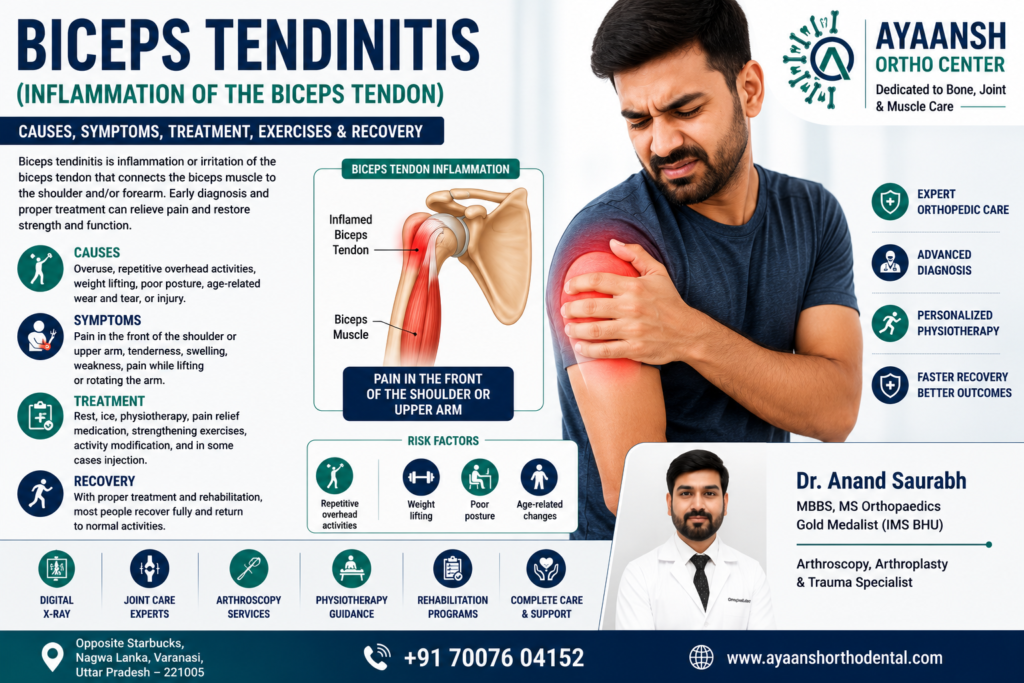
What is Biceps Tendinitis? Understanding the Anatomy
First, we must examine the unique anatomy of the biceps muscle. The biceps brachii is the prominent muscle located on the front of your upper arm. This muscle has two distinct tendons that attach it to the shoulder joint. Consequently, these are known as the long head and the short head.
The short head of the biceps attaches to a bony projection on the shoulder blade called the coracoid process. Generally, this tendon is highly stable and rarely develops issues.
In contrast, the long head of the biceps tendon (LHBT) is long, thin, and highly vulnerable to injury. Specifically, it starts at the top of the shoulder socket, attaching to a cartilage ring called the glenoid labrum. From there, the tendon travels through a narrow canal on the front of the humerus bone called the bicipital groove. A small band of tissue called the transverse humeral ligament keeps the tendon secured in this groove.
When you use your arm, the long head of the biceps tendon slides up and down within this narrow groove. Therefore, repetitive movements can easily cause friction. Over time, this mechanical friction triggers localized swelling and irritation.
Furthermore, chronic cases usually progress from simple inflammation (tendinitis) to structural wear and tear (tendinosis). During tendinosis, the tendon’s collagen fibers become disorganized and weak. This degeneration increases the risk of a partial or complete tendon tear.

Common Causes of Biceps Tendinitis
Generally, cumulative wear and tear from repetitive overhead movements causes biceps tendinitis. Therefore, both active athletes and manual laborers frequently suffer from this condition.
1. Repetitive Overhead Overuse
First, sports that require repetitive overhead motions place immense stress on the LHBT. For instance, swimming, tennis, baseball pitching, and volleyball require rapid arm rotation. Similarly, weightlifters often overload the tendon during heavy shoulder presses, bicep curls, or pull-ups.
2. Occupational Strain
Second, certain occupations require prolonged overhead reaching or heavy lifting. Consequently, painters, carpenters, plumbers, and manual loaders often develop micro-tears in the tendon. Indeed, the risk increases when workers perform these tasks with poor biomechanics.
3. Natural Aging and Degeneration
Third, tendons naturally lose their elasticity and blood supply as we age. Therefore, older adults can develop biceps tendinitis from simple, everyday activities. In these cases, minor movements can trigger significant discomfort due to pre-existing wear.
4. Poor Shoulder Biomechanics
Finally, muscle imbalances around the shoulder blade can overload the biceps tendon. Specifically, if your upper back muscles are weak, your shoulder joint drifts forward. This forward position narrows the space for the biceps tendon, increasing friction during arm movements.

Associated Shoulder Pathologies
Indeed, biceps tendinitis rarely occurs as an isolated injury. Instead, it is usually a secondary symptom of a broader shoulder problem.
- Shoulder Impingement Syndrome: First, the biceps tendon runs directly underneath the acromion bone. If this space narrows, the bone rubs against both the rotator cuff and the biceps tendon. To understand this dynamic, you can read our detailed guide on Shoulder Impingement Syndrome.
- Rotator Cuff Tears: Second, the rotator cuff muscles stabilize the humerus head. If these muscles tear, the humerus moves upward, compressing the adjacent biceps tendon. If you suspect a cuff injury, explore our article on Rotator Cuff Tear Treatment in Varanasi.
- SLAP Lesions: Third, because the LHBT attaches to the superior labrum, a labral tear (SLAP lesion) can destabilize the tendon anchor. Consequently, this leads to chronic biceps pain and joint instability.
- Glenohumeral Arthritis: Finally, joint wear and tear can create rough bone spurs. These spurs can directly irritate the sliding biceps tendon.
Recognizable Symptoms of Biceps Tendinitis
When the biceps tendon becomes inflamed, the symptoms develop gradually. Consequently, patients often ignore the early warning signs until the pain worsens.
- Frontal Shoulder Pain: First, the most common symptom is a deep, aching pain located directly in the front of the shoulder. This pain may travel down the biceps muscle belly.
- Overhead Pain: Second, the discomfort sharpens when you reach your arm overhead, throw a ball, or lift objects.
- Tenderness to Touch: Third, the area directly over the bicipital groove is highly sensitive. Pressing on the front of your shoulder will reproduce the pain.
- Clicking or Snapping Sensation: Fourth, you may feel or hear a snapping sound in the front of your shoulder. This occurs when the tendon slips partially out of the bicipital groove due to a stretched ligament.
- Nighttime Discomfort: Finally, sleeping on the affected shoulder can be highly painful. This often disrupts your sleep cycle.

Clinical Examination and Diagnostic Tests
To formulate a targeted treatment plan, an orthopedic specialist must perform a detailed clinical evaluation. During the physical exam, the doctor will use specific stress tests to isolate the biceps tendon.
- Speed’s Test: First, the doctor asks you to extend your arm forward with your palm facing up. He then applies downward pressure while you try to resist. Pain in the front of the shoulder indicates a positive test.
- Yergason’s Test: Second, you flex your elbow to 90 degrees with your palm facing down. The doctor resists as you try to rotate your palm upward (supination) while turning your arm outward. Sharp pain confirms biceps tendon irritation.
- Palpation: Third, the specialist carefully presses along the bicipital groove. Localized tenderness helps differentiate tendinitis from other joint issues.
Diagnostic Imaging:
- Digital X-rays: While X-rays do not show soft tendons, they help identify bone spurs, joint arthritis, or bicipital groove narrowing.
- High-Resolution Ultrasound: This is an excellent, dynamic tool. It allows the specialist to visualize the tendon’s thickness, fluid accumulation, or structural subluxation in real-time.
- MRI (Magnetic Resonance Imaging): An MRI provides highly detailed, multi-planar views. Consequently, it is the best way to detect partial tendon tears, rotator cuff damage, and labral pathology.
Non-Surgical Treatment Options
Fortunately, the vast majority of patients with biceps tendinitis recover successfully using conservative, non-surgical methods.
1. Rest and Activity Modification
Initially, you must temporarily stop the activities that trigger your pain. Specifically, avoid overhead lifting, throwing, or heavy carrying. This rest phase allows the acute inflammation to subside.
2. Cryotherapy (Ice Application)
Additionally, apply an ice pack wrapped in a thin towel to the front of your shoulder. Do this for 15 minutes, 3 to 4 times a day. Ice effectively constricts local blood vessels, which reduces swelling and numbs the pain.
3. Medications
Furthermore, short-term use of oral anti-inflammatory drugs (NSAIDs) can help manage pain. However, these medications only mask the symptoms. Therefore, you must combine them with physical therapy for a lasting recovery.
4. Advanced Corticosteroid Injections
If severe pain limits your ability to perform therapy, a targeted injection can help. Specifically, the doctor performs an ultrasound-guided injection of a corticosteroid and a local anesthetic directly into the biceps tendon sheath. Consequently, this provides rapid, localized anti-inflammatory relief. However, repeated injections are avoided because they can weaken the tendon structure.
5. Platelet-Rich Plasma (PRP) Therapy
For chronic tendinosis, PRP therapy is an excellent, minimally invasive option. The doctor extracts concentrated growth factors from your own blood and injects them into the damaged tendon. As a result, this stimulates cellular repair and healthy collagen remodeling.

Step-by-Step Physiotherapy and Rehabilitation
Physical therapy is the cornerstone of long-term recovery. A structured rehabilitation program progresses through distinct, carefully managed phases.
Phase 1: Range of Motion and Pain Relief
During this early stage, the goal is to restore normal joint mobility without overloading the healing tendon.
- Pendulum Stretch: Lean forward, supporting your healthy arm on a table. Let your injured arm hang down. Gently swing the arm in small circles. This lubricates the joint and prevents stiffness.
- Passive Shoulder Extension: Hold a stick behind your back with both hands. Gently push the stick backward to stretch the front of your shoulder. Hold for 20 seconds and repeat 3 times.
Phase 2: Isometric and Scapular Stabilization
Next, we focus on strengthening the muscles that support the shoulder blade. This improves overall biomechanics.
- Scapular Retractions: Stand tall with your arms at your sides. Gently squeeze your shoulder blades together, holding for 5 seconds. Repeat 15 times for 3 sets.
- Wall Isometric Flexion: Stand facing a wall. Bend your elbow to 90 degrees and place your fist against the wall. Push forward gently, holding the static contraction for 10 seconds. Repeat 10 times.
Phase 3: Eccentric Biceps Strengthening
Eccentric training—where the muscle elongates under tension—helps remodel the degenerated tendon tissue.
- Eccentric Bicep Curls: Hold a very light dumbbell. Lift the weight using your healthy arm. Then, slowly lower the weight using only your injured arm over a count of 5 seconds. Perform 3 sets of 10 repetitions.
- Internal and External Rotation: Use light resistance bands to strengthen the rotator cuff muscles. This keeps the humerus head centered in the socket, reducing friction on the biceps tendon.
Surgical Treatment: When is it Needed?
Occasionally, conservative treatment fails to provide relief after 6 to 12 months. In these cases, surgical intervention may be necessary.
1. Biceps Tenodesis
First, biceps tenodesis is a highly successful procedure. The surgeon cuts the damaged long head of the biceps tendon from its attachment inside the shoulder joint. Then, the surgeon reattaches the healthy portion of the tendon to the humerus bone using small screws or anchors. Consequently, this removes the painful tendon from the joint while preserving the muscle’s strength and natural shape.
2. Biceps Tenotomy
Second, a biceps tenotomy is a simpler alternative, particularly for older or less active patients. The surgeon releases the long head of the biceps tendon completely, allowing it to fall out of the joint. While this relieves pain, it can result in a cosmetic bulge in the upper arm, often called a “Popeye muscle” deformity. However, most patients experience minimal loss of arm strength.

Prevention and Ergonomic Tips
To protect your biceps tendon from future injuries, consider these preventive strategies:
- Warm-up Thoroughly: Always perform light cardio and dynamic stretches before sports or physical labor.
- Optimize Gym Technique: Avoid dropping weights rapidly during bicep curls or shoulder presses. Control the movement during both the lifting and lowering phases.
- Adjust Workplace Ergonomics: Avoid reaching overhead repeatedly. Use a step stool or ladder to bring objects closer to your natural working height.
- Address Other Pain Early: If you notice early joint issues, seek care promptly. For instance, managing Frozen Shoulder or early rotator cuff irritation can prevent secondary biceps tendinitis.
Expert Care at Ayaansh Ortho Center in Varanasi
If front shoulder pain is affecting your daily routine, seeking specialized care is critical. Ayaansh Ortho Center, located opposite Starbucks, Nagwa Lanka, Varanasi, provides advanced diagnostic and treatment services for shoulder disorders, sports injuries, and joint conditions.
Our orthopedic services are led by Dr. Anand Saurabh (MBBS, MS Orthopaedics), a Gold Medalist from IMS BHU with over 10 years of clinical experience. Dr. Anand Saurabh specializes in arthroscopy, trauma care, and evidence-based regenerative medicine. At our center, we develop personalized, patient-centric treatment plans to help you relieve pain and return to your active lifestyle safely. To learn more about our specialist, visit the profile of Dr. Anand Saurabh.
Related Articles
- Shoulder Impingement Syndrome: Causes & Recovery
- Rotator Cuff Tear Treatment in Varanasi
- Frozen Shoulder Treatment & Exercises
