 Skip to content
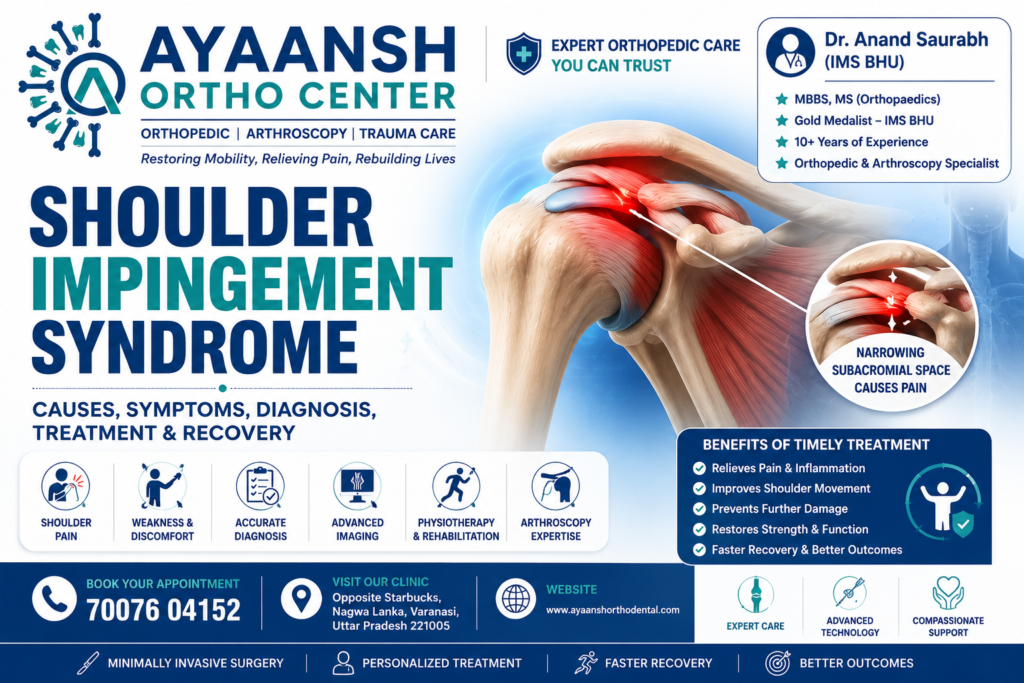
Shoulder pain can make even simple daily activities—such as lifting your arm, combing your hair, driving, or reaching for objects on a shelf—extremely uncomfortable. One of the most common causes of persistent shoulder pain is Shoulder Impingement Syndrome, a condition that develops when the tendons of the rotator cuff become compressed between the bones of the shoulder during movement.
If left untreated, this condition may gradually worsen, resulting in chronic pain, reduced shoulder mobility, muscle weakness, and even rotator cuff tears. Fortunately, with timely diagnosis and appropriate treatment, most patients recover successfully without surgery.
At Ayaansh Ortho Center, Dr. Anand Saurabh (IMS BHU), MBBS, MS Orthopaedics, Gold Medalist, specializes in diagnosing and treating shoulder disorders using evidence-based, patient-centered care. Whether your symptoms are mild or severe, early intervention can help restore shoulder function and prevent long-term complications.
Quick Overview
| Feature | Details |
|---|---|
| Condition | Shoulder Impingement Syndrome |
| Medical Name | Subacromial Impingement Syndrome |
| Affected Area | Shoulder Joint |
| Common Age Group | 30–65 years |
| Common Symptoms | Pain while lifting the arm, weakness, stiffness |
| Major Causes | Repetitive overhead activity, inflammation, bone spurs |
| Diagnosis | Physical examination, X-ray, Ultrasound, MRI |
| Treatment | Rest, medicines, physiotherapy, injections, surgery (selected cases) |
| Recovery Time | 4–12 weeks (depending on severity) |
| Specialist | Orthopedic Surgeon |
What is Shoulder Impingement Syndrome?
Shoulder Impingement Syndrome occurs when the soft tissues inside the shoulder become pinched or compressed during arm movements. The condition usually affects the rotator cuff tendons and the subacromial bursa, leading to inflammation, swelling, pain, and restricted movement.
Normally, there is enough space between the top of the upper arm bone (humerus) and the acromion (part of the shoulder blade). During shoulder impingement, this space becomes narrower, causing the tendons to repeatedly rub against the surrounding bone.
Over time, repeated friction may result in:
- Inflammation
- Tendinitis
- Bursitis
- Partial tendon tears
- Complete rotator cuff tears
- Persistent shoulder stiffness
Without treatment, these problems can significantly reduce shoulder strength and affect quality of life.

Understanding Shoulder Anatomy
A healthy shoulder relies on several structures working together to provide stability and movement.
The shoulder joint consists of:
- Humerus (upper arm bone)
- Scapula (shoulder blade)
- Clavicle (collarbone)
- Acromion
- Glenoid socket
- Rotator cuff muscles
- Rotator cuff tendons
- Bursa
- Shoulder capsule
- Ligaments
Rotator Cuff Muscles
The rotator cuff includes four important muscles:
- Supraspinatus
- Infraspinatus
- Teres Minor
- Subscapularis
These muscles stabilize the shoulder while allowing smooth movement in multiple directions.

Why Does Impingement Occur?
When the space beneath the acromion becomes narrow, the rotator cuff tendon repeatedly rubs against the bone during shoulder movement.
This results in:
- Tendon irritation
- Swelling
- Pain
- Reduced range of motion
- Weakness
As swelling increases, the available space becomes even smaller, creating a cycle of ongoing inflammation and pain.
Common Causes of Shoulder Impingement Syndrome
Several factors can contribute to this condition. In many cases, more than one cause is involved.
Frequent Causes
- Repetitive overhead arm movements
- Sports involving throwing
- Swimming
- Badminton
- Tennis
- Cricket bowling
- Volleyball
- Painting ceilings
- Electric work
- Carpentry
- Construction work
- Poor posture
- Age-related tendon degeneration
- Bone spur formation
- Previous shoulder injury
- Rotator cuff inflammation
- Shoulder instability
- Weak shoulder muscles
Medical Conditions That Increase the Risk
People with the following conditions may have a higher chance of developing shoulder impingement:
- Diabetes
- Thyroid disorders
- Rheumatoid arthritis
- Frozen shoulder
- Previous shoulder dislocation
- Rotator cuff tendinitis
- Arthritis of the shoulder

Risk Factors
The following factors increase the likelihood of Shoulder Impingement Syndrome:
Lifestyle Factors
- Sedentary lifestyle
- Poor posture
- Lack of exercise
- Improper lifting techniques
- Sleeping on one shoulder regularly
Occupational Risks
People working in these professions are at greater risk:
- Electricians
- Painters
- Plumbers
- Carpenters
- Mechanics
- Factory workers
- Nurses
- Surgeons
- Warehouse workers
- Construction workers
Sports at High Risk
Athletes participating in repetitive overhead activities are more susceptible:
- Cricket
- Tennis
- Badminton
- Volleyball
- Swimming
- Baseball
- Weightlifting
- CrossFit
- Gymnastics

Symptoms of Shoulder Impingement Syndrome
Symptoms usually develop gradually rather than suddenly. Initially, patients may notice only mild discomfort while lifting the arm, but over time the pain becomes more persistent.
Common Symptoms
✔ Pain while raising the arm above shoulder level
✔ Pain during overhead activities
✔ Shoulder stiffness
✔ Weakness in the affected arm
✔ Pain while combing hair
✔ Difficulty wearing shirts or jackets
✔ Difficulty reaching behind the back
✔ Pain while driving
✔ Night pain, especially when lying on the affected shoulder
✔ Clicking or popping sensations
✔ Reduced shoulder movement
✔ Pain while lifting heavy objects
✔ Shoulder fatigue after activity
✔ Pain during exercise
✔ Tenderness around the front or side of the shoulder
Symptoms That Should Never Be Ignored
Consult an orthopedic specialist immediately if you experience:
- Severe shoulder pain after an injury
- Inability to lift your arm
- Sudden weakness
- Shoulder deformity
- Persistent night pain
- Pain lasting more than two weeks
- Fever with shoulder pain
- Numbness or tingling in the arm
- Swelling after trauma
- Recurrent shoulder instability

Stages of Shoulder Impingement Syndrome
| Stage | Characteristics | Common Age |
|---|---|---|
| Stage I | Mild inflammation and swelling | Under 25 years |
| Stage II | Tendon thickening, bursitis, increasing pain | 25–40 years |
| Stage III | Bone spurs, tendon degeneration, partial or complete rotator cuff tear | Above 40 years |
Key Takeaways
- Shoulder Impingement Syndrome is one of the most common causes of shoulder pain.
- Early diagnosis improves treatment outcomes.
- Ignoring symptoms can lead to rotator cuff tears.
- Most patients recover successfully with conservative treatment.
- Physiotherapy plays a vital role in restoring shoulder strength and mobility.
- Surgery is required only in selected cases when non-surgical treatment fails.
Diagnosis of Shoulder Impingement Syndrome
Early diagnosis is essential to prevent long-term damage to the rotator cuff tendons and surrounding shoulder structures. At Ayaansh Ortho Center, Dr. Anand Saurabh performs a detailed evaluation that combines your medical history, physical examination, and imaging studies to identify the exact cause of shoulder pain.
Most patients can be diagnosed accurately without invasive procedures.
Medical History
Your orthopedic specialist will ask about:
- When the shoulder pain started
- Whether the pain developed gradually or after an injury
- Activities that increase pain
- Occupation and daily routine
- Sports participation
- Previous shoulder injuries
- History of diabetes or thyroid disorders
- Previous shoulder surgery
- Current medications
- Night pain or sleep disturbances
Physical Examination
During the examination, your doctor evaluates:
- Shoulder posture
- Swelling
- Tenderness
- Range of motion
- Muscle strength
- Shoulder stability
- Rotator cuff function
- Neck movement (to rule out cervical spine problems)

Special Clinical Tests
Several orthopedic tests help confirm Shoulder Impingement Syndrome.
| Test | Purpose | Positive Finding |
|---|---|---|
| Neer Impingement Test | Detects subacromial impingement | Pain while lifting the arm |
| Hawkins-Kennedy Test | Evaluates tendon compression | Sharp shoulder pain |
| Empty Can Test | Assesses supraspinatus tendon | Weakness and pain |
| Painful Arc Test | Identifies impingement | Pain between 60°–120° of arm elevation |
| Drop Arm Test | Detects rotator cuff tear | Difficulty lowering the arm |
| Speed’s Test | Evaluates biceps tendon | Pain in the front of the shoulder |
Imaging Investigations
Imaging helps determine the severity of the condition and rule out other shoulder disorders.
X-ray
An X-ray does not show muscles or tendons but is useful for identifying:
- Bone spurs
- Arthritis
- Fractures
- Acromion shape
- Reduced subacromial space
- Calcific deposits
Ultrasound
Ultrasound provides a dynamic assessment of the shoulder.
It helps detect:
- Rotator cuff inflammation
- Tendinitis
- Bursitis
- Partial tendon tears
- Fluid collection
- Biceps tendon abnormalities
Advantages include:
- Quick examination
- No radiation
- Cost-effective
- Real-time shoulder movement assessment
MRI Scan
MRI is considered the most informative investigation when symptoms persist or surgery is being considered.
MRI can reveal:
- Rotator cuff tears
- Tendon degeneration
- Bursa inflammation
- Muscle atrophy
- Cartilage damage
- Labral injuries
- Bone edema
Comparison of Imaging Tests
| Investigation | Best For | Radiation | Cost | When Recommended |
|---|---|---|---|---|
| X-ray | Bone problems | Yes | Low | Initial evaluation |
| Ultrasound | Tendons & bursae | No | Moderate | Soft tissue assessment |
| MRI | Complete shoulder evaluation | No | Higher | Persistent pain or suspected tear |
Treatment of Shoulder Impingement Syndrome
The goal of treatment is to:
- Reduce pain
- Decrease inflammation
- Restore shoulder movement
- Improve muscle strength
- Prevent rotator cuff tears
- Return patients to normal daily activities
Most patients improve with conservative treatment.
Non-Surgical Treatment
1. Activity Modification
Avoid activities that worsen symptoms.
Examples include:
- Repetitive overhead lifting
- Heavy weightlifting
- Throwing sports
- Painting ceilings
- Sudden jerky movements
- Sleeping on the painful shoulder
Temporary activity modification allows inflamed tissues to heal.
2. Rest
Short-term rest is beneficial during the painful phase.
However, prolonged immobilization should be avoided because it may lead to stiffness and muscle weakness.
3. Ice Therapy
Ice helps reduce inflammation and pain.
Recommended use:
- 15–20 minutes
- 3–4 times daily
- Especially after physical activity
Always wrap the ice pack in a cloth to protect the skin.
4. Medications
Your orthopedic surgeon may prescribe:
- Non-steroidal anti-inflammatory drugs (NSAIDs)
- Pain relievers
- Muscle relaxants (if muscle spasm is present)
- Topical anti-inflammatory gels
Important: Avoid self-medicating for long periods. Painkillers may relieve symptoms temporarily but do not treat the underlying cause.
Physiotherapy for Shoulder Impingement Syndrome
Physiotherapy is one of the most effective treatments and forms the cornerstone of recovery for most patients.
Benefits of Physiotherapy
- Reduces pain
- Improves flexibility
- Restores shoulder mobility
- Strengthens the rotator cuff
- Improves posture
- Corrects muscle imbalance
- Reduces the risk of recurrence
- Enhances overall shoulder function
Common Physiotherapy Modalities
Depending on your condition, your physiotherapist may recommend:
- Stretching exercises
- Rotator cuff strengthening
- Scapular stabilization exercises
- Resistance band exercises
- Manual therapy
- Joint mobilization
- Ultrasound therapy
- TENS therapy
- Postural correction training
- Home exercise program

Best Exercises for Shoulder Impingement Syndrome
Perform exercises only after consultation with your orthopedic surgeon or physiotherapist.
| Exercise | Benefit |
|---|---|
| Pendulum Exercise | Relieves stiffness |
| Wall Crawls | Improves shoulder mobility |
| Cross-Body Stretch | Stretches the posterior capsule |
| Doorway Stretch | Opens the chest muscles |
| External Rotation with Resistance Band | Strengthens the rotator cuff |
| Internal Rotation Exercise | Improves shoulder stability |
| Scapular Retraction | Enhances posture |
| Shoulder Blade Squeeze | Strengthens upper back muscles |
Exercises to Avoid During Recovery
Avoid the following until your doctor advises otherwise:
- Heavy overhead presses
- Behind-the-neck shoulder presses
- Upright rows
- Heavy bench press
- Sudden throwing activities
- Pull-ups during the painful phase
- Heavy dumbbell lateral raises
- Forceful shoulder stretching
Corticosteroid Injections
For patients with severe pain that does not improve with medication and physiotherapy, corticosteroid injections may be considered.
Potential Benefits
- Rapid pain relief
- Reduced inflammation
- Improved shoulder movement
- Better participation in physiotherapy
These injections should be used judiciously and only under the guidance of an orthopedic specialist, as repeated injections may weaken tendon tissue.
When is Surgery Required?
Surgery is recommended only when conservative treatment fails or when significant structural damage is present.
Common Indications
- Persistent pain despite 3–6 months of treatment
- Recurrent shoulder impingement
- Large bone spurs
- Significant rotator cuff tear
- Loss of shoulder function
- Difficulty performing daily activities
- Athletes requiring a return to high-level overhead sports

Arthroscopic Shoulder Surgery
Arthroscopic surgery is a minimally invasive procedure performed through small incisions using a tiny camera and specialized instruments.
During surgery, the orthopedic surgeon may:
- Remove inflamed bursal tissue
- Smooth or reshape the acromion (subacromial decompression)
- Remove bone spurs
- Repair associated rotator cuff tears if present
- Create more space for smooth tendon movement
Advantages of Arthroscopic Surgery
- Smaller incisions
- Less postoperative pain
- Lower risk of infection
- Faster recovery
- Minimal scarring
- Earlier return to daily activities
Key Takeaways
- Most cases of Shoulder Impingement Syndrome improve with early diagnosis and non-surgical treatment.
- Physiotherapy plays a central role in recovery.
- Imaging studies help determine the severity of tendon involvement.
- Corticosteroid injections may provide temporary relief in selected patients.
- Arthroscopic surgery is reserved for persistent symptoms or significant structural damage and generally offers good outcomes when indicated.
Recovery After Shoulder Impingement Syndrome Treatment
The recovery period depends on the severity of the condition, the duration of symptoms before treatment, and whether the patient requires surgery. Most individuals with mild to moderate Shoulder Impingement Syndrome improve with a combination of medication, physiotherapy, activity modification, and strengthening exercises.
Patients who follow their rehabilitation program consistently often regain full shoulder function and return to their normal daily activities without significant limitations.
Recovery Timeline
| Recovery Stage | Expected Progress |
|---|---|
| Week 1–2 | Pain and inflammation begin to reduce with rest, medications, and ice therapy. |
| Week 3–4 | Shoulder mobility gradually improves with supervised physiotherapy. |
| Week 5–8 | Shoulder strength increases and most daily activities become easier. |
| Week 8–12 | Most patients return to work, sports, and routine activities with minimal discomfort. |
| 3–6 Months | Full functional recovery in moderate to severe cases, especially after surgery. |
Recovery may take longer if:
- Treatment is delayed
- A rotator cuff tear is present
- Bone spurs are significant
- Diabetes slows tissue healing
- Rehabilitation exercises are not performed regularly

Do’s During Recovery
Following healthy recovery habits can improve healing and reduce the risk of recurrence.
Recommended Practices
✔ Follow your orthopedic surgeon’s advice.
✔ Attend all physiotherapy sessions.
✔ Perform home exercises as instructed.
✔ Apply ice after exercise if recommended.
✔ Maintain proper posture while sitting and working.
✔ Warm up before sports or gym workouts.
✔ Increase activity gradually.
✔ Sleep on your back or the unaffected side.
✔ Maintain a healthy body weight.
✔ Eat a protein-rich, balanced diet to support tissue healing.
Don’ts During Recovery
Avoid these activities until your doctor advises otherwise:
❌ Ignore persistent shoulder pain.
❌ Lift heavy weights overhead.
❌ Resume sports too early.
❌ Continue activities that increase pain.
❌ Sleep on the painful shoulder.
❌ Skip physiotherapy sessions.
❌ Self-medicate for long periods without medical advice.
❌ Perform sudden jerking shoulder movements.
❌ Ignore increasing weakness or loss of movement.
Possible Complications if Left Untreated
Ignoring Shoulder Impingement Syndrome can lead to progressive damage of the shoulder joint.
Potential Complications
- Chronic shoulder pain
- Rotator cuff tendinitis
- Partial rotator cuff tear
- Complete rotator cuff tear
- Shoulder stiffness
- Frozen shoulder (Adhesive Capsulitis)
- Muscle weakness
- Loss of shoulder function
- Reduced range of motion
- Difficulty performing daily activities
- Sleep disturbances due to persistent pain
Early diagnosis and treatment significantly reduce the risk of these complications.

Can Shoulder Impingement Syndrome Be Prevented?
Although not every case can be prevented, several healthy habits can lower the risk of developing this condition.
Prevention Tips
- Maintain good posture while sitting and standing.
- Strengthen the rotator cuff and shoulder blade muscles.
- Stretch before sports and exercise.
- Avoid repetitive overhead activities without adequate breaks.
- Use proper lifting techniques.
- Improve workstation ergonomics.
- Maintain flexibility of the shoulder and upper back.
- Treat minor shoulder injuries promptly.
- Gradually increase exercise intensity instead of sudden heavy workouts.
- Schedule regular orthopedic evaluations if you have recurring shoulder pain.
When Should You Consult an Orthopedic Surgeon?
Seek medical evaluation if you experience:
- Shoulder pain lasting more than two weeks.
- Pain that worsens during overhead activities.
- Difficulty lifting your arm.
- Night pain that affects sleep.
- Shoulder weakness.
- Clicking or catching sensations.
- Limited range of motion.
- Pain after a fall or sports injury.
- Swelling or visible deformity.
- Symptoms that do not improve with rest and medication.
Early consultation often leads to faster recovery and helps prevent long-term tendon damage.
Shoulder Impingement Syndrome: Myths vs Facts
| Myth | Fact |
|---|---|
| Shoulder pain will always disappear on its own. | Persistent shoulder pain should be evaluated by an orthopedic specialist. |
| Only athletes develop Shoulder Impingement Syndrome. | Office workers, manual laborers, and older adults can also develop the condition. |
| Complete bed rest is the best treatment. | Controlled movement and physiotherapy are essential for recovery. |
| Surgery is required in every case. | Most patients improve with conservative treatment and rehabilitation. |
| Painkillers permanently cure shoulder impingement. | Medications relieve symptoms but do not address the underlying mechanical problem. |
| Once treated, the condition never returns. | Without strengthening exercises and lifestyle modifications, recurrence is possible. |

Frequently Asked Questions (FAQs)
1. What is Shoulder Impingement Syndrome?
It is a condition in which the rotator cuff tendons and surrounding soft tissues become compressed beneath the acromion, causing pain and restricted shoulder movement.
2. Is Shoulder Impingement Syndrome serious?
Most cases are successfully treated without surgery, but delaying treatment can lead to tendon damage and rotator cuff tears.
3. Can Shoulder Impingement heal without surgery?
Yes. The majority of patients recover with rest, physiotherapy, medications, and activity modification.
4. How long does recovery take?
Recovery usually takes 4 to 12 weeks, although severe cases or postoperative rehabilitation may require several months.
5. Can I continue exercising?
High-impact and overhead exercises should be avoided until your orthopedic specialist recommends returning to them. Gentle rehabilitation exercises are usually encouraged.
6. Is physiotherapy necessary?
Yes. Physiotherapy is one of the most effective treatments for improving shoulder mobility, strength, and long-term function.
7. What happens if I ignore shoulder impingement?
Ignoring symptoms can result in chronic pain, stiffness, rotator cuff tears, reduced shoulder strength, and decreased quality of life.
8. Is MRI required for every patient?
No. MRI is usually recommended when symptoms persist despite treatment, when a rotator cuff tear is suspected, or before surgery.
9. Can Shoulder Impingement return after treatment?
Yes. Poor posture, muscle weakness, repetitive overhead activities, or skipping rehabilitation exercises can increase the risk of recurrence.
10. When should I visit an orthopedic specialist?
If shoulder pain lasts longer than two weeks, interferes with daily activities, or is associated with weakness or restricted movement, schedule an orthopedic consultation promptly.
Why Choose Ayaansh Ortho Center?
At Ayaansh Ortho Center, we provide comprehensive orthopedic care with a focus on accurate diagnosis, evidence-based treatment, and personalized rehabilitation plans.
Our Orthopedic Services Include
- Comprehensive shoulder evaluation
- Digital X-ray guidance
- Sports injury management
- Rotator cuff injury treatment
- Arthroscopy consultation
- Joint pain management
- Fracture and trauma care
- Physiotherapy guidance
- Personalized rehabilitation programs
- Long-term preventive care
Meet Your Orthopedic Specialist
Dr. Anand Saurabh
- MBBS
- MS Orthopaedics
- Gold Medalist (IMS BHU)
- More than 10 years of orthopedic experience
- Expertise in Arthroscopy, Arthroplasty (Joint Replacement), and Trauma Care
Conclusion
Shoulder Impingement Syndrome is a common yet highly treatable cause of shoulder pain. Early diagnosis, proper physiotherapy, activity modification, and timely orthopedic care can relieve pain, restore shoulder function, and prevent complications such as rotator cuff tears.
If your shoulder pain is interfering with work, sports, or everyday activities, do not ignore the symptoms. Early treatment offers the best chance of a complete recovery and helps you return to an active, pain-free lifestyle.
External References
Authoritative medical sources.
American Academy of Orthopaedic Surgeons (AAOS)
National Institute of Arthritis and Musculoskeletal and Skin Diseases (NIAMS)
MedlinePlus
Mayo Clinic
Book an Appointment
If you are experiencing persistent shoulder pain, difficulty lifting your arm, or reduced shoulder mobility, consult Dr. Anand Saurabh at Ayaansh Ortho Center for expert evaluation and personalized treatment.
Ayaansh Ortho Center
Opposite Starbucks, Nagwa Lanka, Varanasi, Uttar Pradesh – 221005
Call: +91 70076 04152
