 Skip to content

A rotator cuff tear is one of the most frequent causes of chronic shoulder pain in adults. It affects the group of four muscles and tendons that stabilize the shoulder and help lift and rotate the arm. Whether caused by aging, repetitive overhead work, sports injuries, or trauma, early diagnosis greatly improves recovery. If you are looking for rotator cuff tear treatment in Varanasi, understanding the symptoms, diagnosis, treatment options, exercises, and recovery timeline can help you make informed decisions about your care.
Understanding the Rotator Cuff
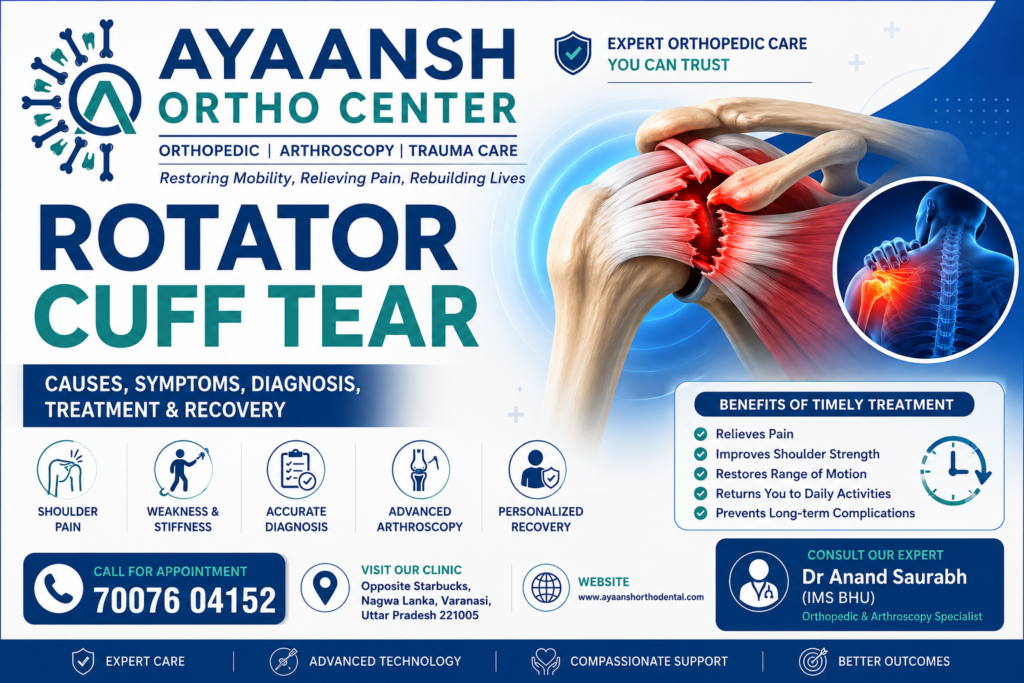
The rotator cuff consists of the supraspinatus, infraspinatus, teres minor, and subscapularis muscles. Together they keep the shoulder stable while allowing smooth movement. Damage to any of these tendons can lead to pain, weakness, and reduced function. Early evaluation prevents progression of tendon damage and helps patients return to daily activities sooner. Individualized treatment plans based on clinical findings generally produce better outcomes than self-treatment. Following medical advice, avoiding activities that worsen symptoms, and attending physiotherapy sessions regularly are important for restoring function and reducing the chance of recurrence.
The rotator cuff consists of the supraspinatus, infraspinatus, teres minor, and subscapularis muscles. Together they keep the shoulder stable while allowing smooth movement. Damage to any of these tendons can lead to pain, weakness, and reduced function. Early evaluation prevents progression of tendon damage and helps patients return to daily activities sooner. Individualized treatment plans based on clinical findings generally produce better outcomes than self-treatment. Following medical advice, avoiding activities that worsen symptoms, and attending physiotherapy sessions regularly are important for restoring function and reducing the chance of recurrence.
The rotator cuff consists of the supraspinatus, infraspinatus, teres minor, and subscapularis muscles. Together they keep the shoulder stable while allowing smooth movement. Damage to any of these tendons can lead to pain, weakness, and reduced function. Early evaluation prevents progression of tendon damage and helps patients return to daily activities sooner. Individualized treatment plans based on clinical findings generally produce better outcomes than self-treatment. Following medical advice, avoiding activities that worsen symptoms, and attending physiotherapy sessions regularly are important for restoring function and reducing the chance of recurrence.
The rotator cuff consists of the supraspinatus, infraspinatus, teres minor, and subscapularis muscles. Together they keep the shoulder stable while allowing smooth movement. Damage to any of these tendons can lead to pain, weakness, and reduced function. Early evaluation prevents progression of tendon damage and helps patients return to daily activities sooner. Individualized treatment plans based on clinical findings generally produce better outcomes than self-treatment. Following medical advice, avoiding activities that worsen symptoms, and attending physiotherapy sessions regularly are important for restoring function and reducing the chance of recurrence.
Types of Rotator Cuff Tears
Rotator cuff tears may be partial-thickness or full-thickness. Partial tears involve only part of the tendon, while complete tears separate the tendon from the bone. Acute tears usually follow trauma, whereas degenerative tears develop slowly over years. Early evaluation prevents progression of tendon damage and helps patients return to daily activities sooner. Individualized treatment plans based on clinical findings generally produce better outcomes than self-treatment. Following medical advice, avoiding activities that worsen symptoms, and attending physiotherapy sessions regularly are important for restoring function and reducing the chance of recurrence.
Rotator cuff tears may be partial-thickness or full-thickness. Partial tears involve only part of the tendon, while complete tears separate the tendon from the bone. Acute tears usually follow trauma, whereas degenerative tears develop slowly over years. Early evaluation prevents progression of tendon damage and helps patients return to daily activities sooner. Individualized treatment plans based on clinical findings generally produce better outcomes than self-treatment. Following medical advice, avoiding activities that worsen symptoms, and attending physiotherapy sessions regularly are important for restoring function and reducing the chance of recurrence.
Rotator cuff tears may be partial-thickness or full-thickness. Partial tears involve only part of the tendon, while complete tears separate the tendon from the bone. Acute tears usually follow trauma, whereas degenerative tears develop slowly over years. Early evaluation prevents progression of tendon damage and helps patients return to daily activities sooner. Individualized treatment plans based on clinical findings generally produce better outcomes than self-treatment. Following medical advice, avoiding activities that worsen symptoms, and attending physiotherapy sessions regularly are important for restoring function and reducing the chance of recurrence.
Rotator cuff tears may be partial-thickness or full-thickness. Partial tears involve only part of the tendon, while complete tears separate the tendon from the bone. Acute tears usually follow trauma, whereas degenerative tears develop slowly over years. Early evaluation prevents progression of tendon damage and helps patients return to daily activities sooner. Individualized treatment plans based on clinical findings generally produce better outcomes than self-treatment. Following medical advice, avoiding activities that worsen symptoms, and attending physiotherapy sessions regularly are important for restoring function and reducing the chance of recurrence.

Causes
Common causes include aging, repetitive overhead activities, heavy lifting, sports such as cricket, badminton, volleyball, previous shoulder injuries, poor posture, smoking, diabetes, and reduced blood supply to the tendon. Early evaluation prevents progression of tendon damage and helps patients return to daily activities sooner. Individualized treatment plans based on clinical findings generally produce better outcomes than self-treatment. Following medical advice, avoiding activities that worsen symptoms, and attending physiotherapy sessions regularly are important for restoring function and reducing the chance of recurrence.
Common causes include aging, repetitive overhead activities, heavy lifting, sports such as cricket, badminton, volleyball, previous shoulder injuries, poor posture, smoking, diabetes, and reduced blood supply to the tendon. Early evaluation prevents progression of tendon damage and helps patients return to daily activities sooner. Individualized treatment plans based on clinical findings generally produce better outcomes than self-treatment. Following medical advice, avoiding activities that worsen symptoms, and attending physiotherapy sessions regularly are important for restoring function and reducing the chance of recurrence.
Common causes include aging, repetitive overhead activities, heavy lifting, sports such as cricket, badminton, volleyball, previous shoulder injuries, poor posture, smoking, diabetes, and reduced blood supply to the tendon. Early evaluation prevents progression of tendon damage and helps patients return to daily activities sooner. Individualized treatment plans based on clinical findings generally produce better outcomes than self-treatment. Following medical advice, avoiding activities that worsen symptoms, and attending physiotherapy sessions regularly are important for restoring function and reducing the chance of recurrence.
Common causes include aging, repetitive overhead activities, heavy lifting, sports such as cricket, badminton, volleyball, previous shoulder injuries, poor posture, smoking, diabetes, and reduced blood supply to the tendon. Early evaluation prevents progression of tendon damage and helps patients return to daily activities sooner. Individualized treatment plans based on clinical findings generally produce better outcomes than self-treatment. Following medical advice, avoiding activities that worsen symptoms, and attending physiotherapy sessions regularly are important for restoring function and reducing the chance of recurrence.
Symptoms
Typical symptoms include shoulder pain, weakness while lifting the arm, pain at night, clicking sensations, difficulty combing hair or dressing, reduced range of motion, and inability to perform overhead activities. Early evaluation prevents progression of tendon damage and helps patients return to daily activities sooner. Individualized treatment plans based on clinical findings generally produce better outcomes than self-treatment. Following medical advice, avoiding activities that worsen symptoms, and attending physiotherapy sessions regularly are important for restoring function and reducing the chance of recurrence.
Typical symptoms include shoulder pain, weakness while lifting the arm, pain at night, clicking sensations, difficulty combing hair or dressing, reduced range of motion, and inability to perform overhead activities. Early evaluation prevents progression of tendon damage and helps patients return to daily activities sooner. Individualized treatment plans based on clinical findings generally produce better outcomes than self-treatment. Following medical advice, avoiding activities that worsen symptoms, and attending physiotherapy sessions regularly are important for restoring function and reducing the chance of recurrence.
Typical symptoms include shoulder pain, weakness while lifting the arm, pain at night, clicking sensations, difficulty combing hair or dressing, reduced range of motion, and inability to perform overhead activities. Early evaluation prevents progression of tendon damage and helps patients return to daily activities sooner. Individualized treatment plans based on clinical findings generally produce better outcomes than self-treatment. Following medical advice, avoiding activities that worsen symptoms, and attending physiotherapy sessions regularly are important for restoring function and reducing the chance of recurrence.
Typical symptoms include shoulder pain, weakness while lifting the arm, pain at night, clicking sensations, difficulty combing hair or dressing, reduced range of motion, and inability to perform overhead activities. Early evaluation prevents progression of tendon damage and helps patients return to daily activities sooner. Individualized treatment plans based on clinical findings generally produce better outcomes than self-treatment. Following medical advice, avoiding activities that worsen symptoms, and attending physiotherapy sessions regularly are important for restoring function and reducing the chance of recurrence.

Diagnosis
Diagnosis begins with a detailed history and orthopedic examination. The doctor evaluates shoulder strength, movement, and special clinical tests. X-rays rule out fractures or arthritis, while MRI provides detailed information regarding tendon damage. Ultrasound is another useful imaging option in experienced hands. Early evaluation prevents progression of tendon damage and helps patients return to daily activities sooner. Individualized treatment plans based on clinical findings generally produce better outcomes than self-treatment. Following medical advice, avoiding activities that worsen symptoms, and attending physiotherapy sessions regularly are important for restoring function and reducing the chance of recurrence.
Diagnosis begins with a detailed history and orthopedic examination. The doctor evaluates shoulder strength, movement, and special clinical tests. X-rays rule out fractures or arthritis, while MRI provides detailed information regarding tendon damage. Ultrasound is another useful imaging option in experienced hands. Early evaluation prevents progression of tendon damage and helps patients return to daily activities sooner. Individualized treatment plans based on clinical findings generally produce better outcomes than self-treatment. Following medical advice, avoiding activities that worsen symptoms, and attending physiotherapy sessions regularly are important for restoring function and reducing the chance of recurrence.
Diagnosis begins with a detailed history and orthopedic examination. The doctor evaluates shoulder strength, movement, and special clinical tests. X-rays rule out fractures or arthritis, while MRI provides detailed information regarding tendon damage. Ultrasound is another useful imaging option in experienced hands. Early evaluation prevents progression of tendon damage and helps patients return to daily activities sooner. Individualized treatment plans based on clinical findings generally produce better outcomes than self-treatment. Following medical advice, avoiding activities that worsen symptoms, and attending physiotherapy sessions regularly are important for restoring function and reducing the chance of recurrence.
Diagnosis begins with a detailed history and orthopedic examination. The doctor evaluates shoulder strength, movement, and special clinical tests. X-rays rule out fractures or arthritis, while MRI provides detailed information regarding tendon damage. Ultrasound is another useful imaging option in experienced hands. Early evaluation prevents progression of tendon damage and helps patients return to daily activities sooner. Individualized treatment plans based on clinical findings generally produce better outcomes than self-treatment. Following medical advice, avoiding activities that worsen symptoms, and attending physiotherapy sessions regularly are important for restoring function and reducing the chance of recurrence.
Treatment
Treatment depends on age, activity level, tear size, and symptoms. Non-surgical management includes rest, medications, ice therapy, physiotherapy, posture correction, and gradual strengthening. Larger tears, traumatic injuries, or persistent weakness may require arthroscopic repair followed by structured rehabilitation. Early evaluation prevents progression of tendon damage and helps patients return to daily activities sooner. Individualized treatment plans based on clinical findings generally produce better outcomes than self-treatment. Following medical advice, avoiding activities that worsen symptoms, and attending physiotherapy sessions regularly are important for restoring function and reducing the chance of recurrence.
Treatment depends on age, activity level, tear size, and symptoms. Non-surgical management includes rest, medications, ice therapy, physiotherapy, posture correction, and gradual strengthening. Larger tears, traumatic injuries, or persistent weakness may require arthroscopic repair followed by structured rehabilitation. Early evaluation prevents progression of tendon damage and helps patients return to daily activities sooner. Individualized treatment plans based on clinical findings generally produce better outcomes than self-treatment. Following medical advice, avoiding activities that worsen symptoms, and attending physiotherapy sessions regularly are important for restoring function and reducing the chance of recurrence.
Treatment depends on age, activity level, tear size, and symptoms. Non-surgical management includes rest, medications, ice therapy, physiotherapy, posture correction, and gradual strengthening. Larger tears, traumatic injuries, or persistent weakness may require arthroscopic repair followed by structured rehabilitation. Early evaluation prevents progression of tendon damage and helps patients return to daily activities sooner. Individualized treatment plans based on clinical findings generally produce better outcomes than self-treatment. Following medical advice, avoiding activities that worsen symptoms, and attending physiotherapy sessions regularly are important for restoring function and reducing the chance of recurrence.
Treatment depends on age, activity level, tear size, and symptoms. Non-surgical management includes rest, medications, ice therapy, physiotherapy, posture correction, and gradual strengthening. Larger tears, traumatic injuries, or persistent weakness may require arthroscopic repair followed by structured rehabilitation. Early evaluation prevents progression of tendon damage and helps patients return to daily activities sooner. Individualized treatment plans based on clinical findings generally produce better outcomes than self-treatment. Following medical advice, avoiding activities that worsen symptoms, and attending physiotherapy sessions regularly are important for restoring function and reducing the chance of recurrence.

Physiotherapy
Physiotherapy focuses on restoring flexibility, strengthening the rotator cuff and scapular muscles, correcting posture, and improving shoulder mechanics. Consistent supervised exercises significantly improve long-term outcomes. Early evaluation prevents progression of tendon damage and helps patients return to daily activities sooner. Individualized treatment plans based on clinical findings generally produce better outcomes than self-treatment. Following medical advice, avoiding activities that worsen symptoms, and attending physiotherapy sessions regularly are important for restoring function and reducing the chance of recurrence.
Physiotherapy focuses on restoring flexibility, strengthening the rotator cuff and scapular muscles, correcting posture, and improving shoulder mechanics. Consistent supervised exercises significantly improve long-term outcomes. Early evaluation prevents progression of tendon damage and helps patients return to daily activities sooner. Individualized treatment plans based on clinical findings generally produce better outcomes than self-treatment. Following medical advice, avoiding activities that worsen symptoms, and attending physiotherapy sessions regularly are important for restoring function and reducing the chance of recurrence.
Physiotherapy focuses on restoring flexibility, strengthening the rotator cuff and scapular muscles, correcting posture, and improving shoulder mechanics. Consistent supervised exercises significantly improve long-term outcomes. Early evaluation prevents progression of tendon damage and helps patients return to daily activities sooner. Individualized treatment plans based on clinical findings generally produce better outcomes than self-treatment. Following medical advice, avoiding activities that worsen symptoms, and attending physiotherapy sessions regularly are important for restoring function and reducing the chance of recurrence.
Physiotherapy focuses on restoring flexibility, strengthening the rotator cuff and scapular muscles, correcting posture, and improving shoulder mechanics. Consistent supervised exercises significantly improve long-term outcomes. Early evaluation prevents progression of tendon damage and helps patients return to daily activities sooner. Individualized treatment plans based on clinical findings generally produce better outcomes than self-treatment. Following medical advice, avoiding activities that worsen symptoms, and attending physiotherapy sessions regularly are important for restoring function and reducing the chance of recurrence.
Recovery
Recovery after conservative treatment often takes several weeks, while surgical recovery usually requires four to six months of rehabilitation. Full tendon healing and strength improvements may continue for up to one year. Early evaluation prevents progression of tendon damage and helps patients return to daily activities sooner. Individualized treatment plans based on clinical findings generally produce better outcomes than self-treatment. Following medical advice, avoiding activities that worsen symptoms, and attending physiotherapy sessions regularly are important for restoring function and reducing the chance of recurrence.
Recovery after conservative treatment often takes several weeks, while surgical recovery usually requires four to six months of rehabilitation. Full tendon healing and strength improvements may continue for up to one year. Early evaluation prevents progression of tendon damage and helps patients return to daily activities sooner. Individualized treatment plans based on clinical findings generally produce better outcomes than self-treatment. Following medical advice, avoiding activities that worsen symptoms, and attending physiotherapy sessions regularly are important for restoring function and reducing the chance of recurrence.
Recovery after conservative treatment often takes several weeks, while surgical recovery usually requires four to six months of rehabilitation. Full tendon healing and strength improvements may continue for up to one year. Early evaluation prevents progression of tendon damage and helps patients return to daily activities sooner. Individualized treatment plans based on clinical findings generally produce better outcomes than self-treatment. Following medical advice, avoiding activities that worsen symptoms, and attending physiotherapy sessions regularly are important for restoring function and reducing the chance of recurrence.
Recovery after conservative treatment often takes several weeks, while surgical recovery usually requires four to six months of rehabilitation. Full tendon healing and strength improvements may continue for up to one year. Early evaluation prevents progression of tendon damage and helps patients return to daily activities sooner. Individualized treatment plans based on clinical findings generally produce better outcomes than self-treatment. Following medical advice, avoiding activities that worsen symptoms, and attending physiotherapy sessions regularly are important for restoring function and reducing the chance of recurrence.

Exercises Recommended by Orthopedic Specialists
• Pendulum exercise: Perform only after professional evaluation. Exercises should be pain-free, controlled, and progressed gradually.
• Wall climbing exercise: Perform only after professional evaluation. Exercises should be pain-free, controlled, and progressed gradually.
• Passive forward elevation: Perform only after professional evaluation. Exercises should be pain-free, controlled, and progressed gradually.
• External rotation with resistance band: Perform only after professional evaluation. Exercises should be pain-free, controlled, and progressed gradually.
• Scapular retraction: Perform only after professional evaluation. Exercises should be pain-free, controlled, and progressed gradually.
• Sleeper stretch: Perform only after professional evaluation. Exercises should be pain-free, controlled, and progressed gradually.
• Cross-body stretch: Perform only after professional evaluation. Exercises should be pain-free, controlled, and progressed gradually.
• Isometric shoulder strengthening: Perform only after professional evaluation. Exercises should be pain-free, controlled, and progressed gradually.
Activities to Avoid
Avoid sudden overhead lifting, throwing sports during recovery, carrying heavy loads on the affected side, ignoring persistent pain, and aggressive stretching without professional guidance. Continuing strenuous activities despite symptoms may enlarge the tear and delay healing. Avoid sudden overhead lifting, throwing sports during recovery, carrying heavy loads on the affected side, ignoring persistent pain, and aggressive stretching without professional guidance. Continuing strenuous activities despite symptoms may enlarge the tear and delay healing.

Frequently Asked Questions
Can a rotator cuff tear heal without surgery?
Many partial tears respond well to medications, physiotherapy, and activity modification.
Is surgery always necessary?
No. Surgery is generally considered for large traumatic tears, significant weakness, or failure of conservative treatment.
How long does recovery take?
Recovery varies from weeks to several months depending on treatment and tear severity.
Can I exercise with a tear?
Yes, but only with exercises recommended by your orthopedic surgeon or physiotherapist.
Which doctor should I consult?
Consult an orthopedic specialist experienced in shoulder conditions.
Expert Care at Ayaansh Ortho Center
Ayaansh Ortho Center, Opposite Starbucks, Nagwa Lanka, Varanasi, provides comprehensive diagnosis and treatment for shoulder disorders, sports injuries, arthritis, fractures, and spine conditions. Dr. Anand Saurabh (MBBS, MS Orthopaedics), Gold Medalist from IMS BHU with over 10 years of experience, specializes in arthroscopy, arthroplasty, trauma care, and evidence-based orthopedic management. Patients receive personalized treatment plans designed to relieve pain, restore movement, and improve long-term quality of life.
